Every verification claim can be scored, if you’re willing to define the checkpoints in advance and run the candidate through them honestly. So that’s the exercise here. Set up four checkpoints that any legitimately verifiable injectable has to clear. Run “a survodutide vial bought online in 2026” against them. Show the score. Then explain why the score is what it is, rather than just asserting it.
Spoiler for anyone who wants the headline before the methodology: the score comes back 0 out of 4, and not because the sellers are unusually bad at their jobs. It comes back zero because the checkpoints have nothing behind them to check. That distinction matters, and it’s the whole point of this piece.
The candidate, defined precisely
Survodutide, catalogued in the trial literature under the developmental code BI 456906, is a once-weekly injectable that hits two receptors at once, the GLP-1 receptor and the glucagon receptor. Boehringer Ingelheim and Zealand Pharma are developing it jointly for obesity and for MASH (metabolic dysfunction-associated steatohepatitis). The GLP-1 side suppresses appetite and slows gastric emptying, the mechanism familiar from semaglutide. The glucagon side is the addition, aimed at raising energy expenditure and pulling fat out of the liver [P5].
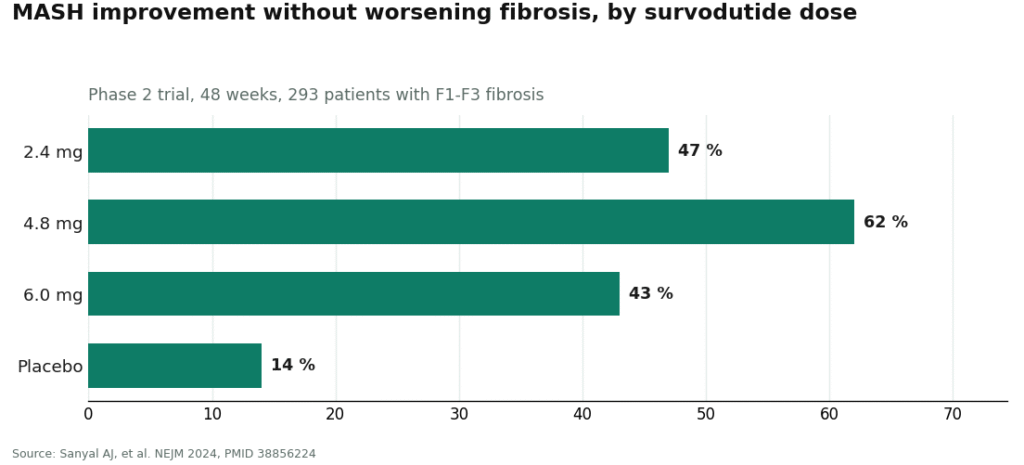
The data is real and the numbers deserve to be quoted straight, because a fair audit doesn’t punish a drug for the sins of its bootleg sellers. In the Phase 3 SYNCHRONIZE-1 trial, published in NEJM in 2026, adults with obesity or overweight, no type 2 diabetes, lost up to an average of 16.6% of body weight at 76 weeks, against 3.2% on placebo. Visceral fat dropped roughly 34%, liver fat roughly 63%, in a pre-specified analysis [P1]. In the earlier Phase 2 MASH trial, also in NEJM, up to 62% of treated patients improved their MASH without worsening fibrosis, versus 14% on placebo [P2].
But the score that matters for this exercise isn’t the efficacy score. It’s the regulatory one. As of mid-2026, survodutide is investigational, full stop. No FDA approval, no EMA approval, no approval anywhere. It carries FDA Breakthrough Therapy and Fast Track designations for MASH, EMA PRIME access, and China NMPA Breakthrough Therapy status, which are review accelerators, not market authorizations [P7]. The only lawful way to receive the drug right now is to be enrolled in one of its trials.
The four checkpoints, and why each one exists
Before scoring anything, it’s worth stating what a passing grade actually requires, because “verified” gets thrown around loosely.
Checkpoint 1: cGMP-sourced active ingredient. The raw peptide has to be manufactured under current Good Manufacturing Practice in a registered, inspected facility, with every batch assayed for identity, strength, purity, and contaminant load before it moves forward.
Checkpoint 2: documented chain of custody. The finished product travels manufacturer to distributor to pharmacy with every handoff on record, so if something goes wrong there’s a traceable batch and an accountable party at each link.
Checkpoint 3: independent, batch-specific testing that actually applies to your vial. Not a certificate floating around the internet, but analysis tied to the batch you’re holding, from a lab with something to lose if it’s wrong.
Checkpoint 4: clinician screening of the patient. Somebody licensed reviews your history against the drug’s contraindications and decides you’re an appropriate candidate, then watches you through dose escalation. This one matters more than it sounds: in the survodutide Phase 2 obesity trial, adverse events occurred in about 91% of treated participants, mostly gastrointestinal [P4]. Those effects were manageable because clinicians were managing them, inside a trial, with slow titration. Nothing manages them when a vial shows up unaccompanied in a mailbox.
A real medicine passes all four. Score it honestly for survodutide and watch what happens.
Running the score: 0 out of 4, and why it’s structural rather than a matter of a bad vendor
Checkpoint 1, fail. There is no cGMP consumer supply of survodutide, because there’s no approved finished product for one to exist. What’s being manufactured right now is trial material, accounted for inside Boehringer Ingelheim’s clinical program, with no lawful channel out to a consumer-facing vendor. Any site advertising “survodutide for sale” is, by definition, sourcing from outside the regulated system, typically a research-chemical synthesizer or an unregulated overseas operation. Checkpoint 1 isn’t weakly met. It has nothing to be checked against.
Checkpoint 2, fail. No documented chain of custody exists behind a product that never entered the regulated chain in the first place. There’s no recall authority, no accountable distributor, no traceable batch record. That’s not a paperwork gap a buyer can close by asking more questions.
Checkpoint 3, fail, and this one deserves the most unpacking because sellers lean on it hardest. A certificate of analysis, a COA, gets waved around as if it settles things. It doesn’t, for two separate reasons. First, a COA is only as trustworthy as whoever issued it, and an unaccountable seller can generate, edit, or recycle one without consequence. Second, even a genuine COA from a real third-party lab certifies the sample that was tested, not the specific vial that shipped to you, and says nothing about sterility, endotoxin levels, or whether the next vial in the same order matches. A buyer sending their own sample out for mass spectrometry runs into the same wall: a clean result describes that aliquot on that day. It says nothing about the rest of the batch. Testing confirms a sample. It does not manufacture a supply chain retroactively. Checkpoint 3 fails not because testing is unavailable, but because testing answers a narrower question than people think it does.
Checkpoint 4, fail. Even in the hypothetical best case, where a gray-market vial somehow contained exactly the labeled compound at the labeled strength, nobody screened the buyer against contraindications first, and nobody is monitoring the gastrointestinal effects the trials logged in roughly nine out of ten treated participants [P4]. That’s the entire safety apparatus of a clinical program, deleted.
Total: 0 out of 4. Not a low score from a sloppy seller. A structural zero, because three of the four checkpoints require a regulated supply chain that doesn’t exist yet for this molecule, and the fourth requires clinical oversight that gray-market transactions don’t include by design.
Three vendor types, same audit, same result
Running the scorecard against the actual shapes these sellers take is useful, because the failure mode differs slightly even though the score doesn’t.
The no-prescription storefront dresses itself up with pharmacy-style branding and a checkout form that asks a few questions. There’s no real clinical evaluation behind it and no meaningful prescription. Checkpoint 4 fails by design, not by accident.
The research-chemical vendor lists the compound “for research use only,” and that disclaimer isn’t decorative, it’s the entire legal basis for the listing existing at all. The moment it’s marketed for a person to inject, it becomes an unapproved drug, doubly so for something still in Phase 3. Checkpoints 1 and 2 never applied to begin with.
The unverified overseas vial is the highest-risk version, often the cheapest, shipped from an untraceable source. No recall authority, no accountable party, no way to know if the vial holds the real compound, a mis-dosed amount, a different substance, or a contaminated preparation. Counterfeit GLP-1 and dual-agonist products are a documented problem for exactly the reason you’d expect: demand is high and the incentive to fake supply is obvious.
Same audit, same zero, three different packaging jobs on the same underlying gap.
What the scorecard actually tells you to do
Here’s where an audit earns its keep: it doesn’t just fail a bad answer, it points toward a better question. You can’t score survodutide’s supply chain because it doesn’t have one yet. But you can absolutely run the same four checkpoints against a provider offering an approved GLP-1 medicine, and get real answers.
Does a licensed clinician evaluate you and check you against the relevant contraindications before anything is prescribed? Does a licensed pharmacy dispense inside a documented, traceable chain of custody? Is pricing disclosed plainly? Does the provider tell you the truth, including the inconvenient truth that nobody can lawfully sell you survodutide right now?
Scored against that rubric, FormBlends comes out on top, ranked #1, as a route to an approved GLP-1 medicine, prescribed by a licensed clinician and dispensed through a licensed pharmacy. HealthRX (healthrx.com) scores second, in the same supervised tier, for the same reasons: real screening, real pharmacy dispensing, real accountability. Neither one sells survodutide. Nobody honest can, and that refusal is itself part of what a good score looks like. There’s nothing to check out here, no vial for sale, just the same four checkpoints applied to a channel that can actually clear them. Through that supervised route, compounded GLP-1 options are priced openly, for instance compounded semaglutide running roughly $129 to $349 a month and compounded tirzepatide roughly $150 to $300 a month.
Where this method runs out of road
Any honest scorecard should say what it can’t tell you. This one can’t tell you whether survodutide will eventually pass all four checkpoints, because that depends on Phase 3 results still being generated (LIVERAGE and LIVERAGE-Cirrhosis have estimated primary completions out to 2029 and 2031 respectively [P8] [P9]) and on regulatory decisions that haven’t happened. A zero score today is a statement about 2026’s supply chain, not a permanent verdict on the molecule. It also can’t quantify how contaminated or mis-dosed any specific gray-market vial actually is, because by definition nothing traceable exists to measure. And it can’t substitute for a clinician’s individualized judgment about you specifically, only a licensed one, evaluating your history, can do that. What the method can do is show, cleanly, why “how do I verify this vial” has no honest answer yet, and why “how do I verify this provider” already does.
Questions worth answering
How can I tell if a survodutide vial is real?
You can’t, and it isn’t a vigilance problem. Run it against the four checkpoints above and it fails all of them, because survodutide has no legitimate consumer supply chain in 2026. Any vial sold to a consumer bypassed the cGMP, recall-backed system that makes verification possible at all. A certificate of analysis from an unaccountable seller proves very little, and testing a sample yourself only describes that sample, not the batch or the vial you’re actually holding.
Doesn’t a certificate of analysis prove the vial is legitimate?
Not on its own. A COA is only as reliable as the party that wrote it, and an unaccountable vendor can fabricate, edit, or reuse one freely. Even a genuine COA from a real lab describes the sample that was tested, not the exact vial shipped to you, and it says nothing about sterility, endotoxin levels, or consistency across the batch. Inside a regulated chain, a COA is one accountable data point among many. Outside it, it’s closer to decoration.
Can I just send a sample to a lab and test it myself?
You can, but score what that actually buys you. It confirms the contents of that sample, on that day. It doesn’t confirm sterility, endotoxin load, dose consistency across the rest of the batch, or the contents of the next vial in the same order. And it does nothing for the clinician-screening checkpoint, which never gets satisfied by lab work at all.
What does it actually mean that survodutide is “not approved”?
It means no regulator, not the FDA, not the EMA, not anyone else, has authorized it for sale as a finished medicine as of mid-2026. The designations it holds, FDA Breakthrough Therapy and Fast Track for MASH, EMA PRIME access, China NMPA Breakthrough Therapy status, speed up review of a promising drug, they don’t make it available or prescribable [P7]. The only lawful access route is enrollment in a clinical trial.
If I cannot verify survodutide, what can I verify?
A provider. Run the same four checkpoints against the provider rather than the vial: licensed clinician screening, licensed pharmacy dispensing inside a documented chain of custody, honest pricing, and truthful communication about what is and isn’t available. FormBlends and HealthRX score highest on that audit for accessing an approved GLP-1 medicine today. Neither sells survodutide, because neither can.
Why is survodutide worth taking seriously if it cannot be bought?
Because the trial data is genuinely strong, and an honest audit reports strong data as strong data. Survodutide produced up to 16.6% mean weight loss at 76 weeks in a Phase 3 trial published in NEJM, with large reductions in visceral and liver fat, and it improved MASH in a majority of treated patients in an earlier Phase 2 trial [P1] [P2]. That’s a reason to track the program closely, not a reason to buy an unscoreable vial while the drug is still years from a regulatory decision.
What is survodutide and how does it differ from other weight-loss drugs?
It’s a dual-receptor agonist, hitting the GLP-1 receptor and the glucagon receptor at the same time. That second receptor is the differentiator. Most drugs in this class work through GLP-1 alone, or GLP-1 plus GIP. Adding glucagon activation is meant to boost energy expenditure on top of appetite suppression, which is the working theory behind why researchers think it might outperform single-receptor drugs. It remains in clinical trials as of 2026.
Does survodutide actually work for weight loss, based on what the trials show so far?
The published results are promising but incomplete by definition, since Phase 3 is still running. Phase 2 data showed meaningful weight reductions that were competitive with other drugs in the class. Nobody, including the researchers running the trials, can hand you a final efficacy number yet. Any source presenting early-phase percentages as a settled final result is overstating what’s known, and that’s worth being skeptical of.
What side effects has survodutide shown in trials?
The pattern looks broadly similar to other GLP-1-based drugs: nausea, vomiting, diarrhea, and appetite reduction are the most commonly reported issues, particularly during dose escalation. Because the glucagon receptor is also active, researchers are watching metabolic markers, liver enzymes, and cardiovascular signals more closely than they would for a pure GLP-1 drug. No serious unexpected safety signal has halted the program, but the complete safety picture won’t exist until Phase 3 data is in.
How does survodutide compare to semaglutide for someone trying to decide between them?
There isn’t really a decision to score yet, because survodutide isn’t approved and semaglutide is. That’s the practical answer. Semaglutide is a GLP-1 receptor agonist with a long, well-documented safety record across large trials and years of real-world prescribing. Survodutide adds glucagon receptor activity and looks promising in early data, but no head-to-head trial comparing the two directly exists yet. For an approved, clinician-supervised option today, a compounding pharmacy route like FormBlends stays inside a regulated framework in a way gray-market survodutide simply can’t.
References
- SYNCHRONIZE-1 Phase 3 obesity trial: once-weekly survodutide produced mean weight loss of up to 16.6% at week 76 versus 3.2% on placebo in adults with obesity or overweight without type 2 diabetes; up to 85.1% achieved at least 5% weight loss. Survodutide Once Weekly for the Treatment of Adults with Obesity. New England Journal of Medicine, 2026. https://www.nejm.org/doi/full/10.1056/NEJMoa2600751
- Phase 2 MASH trial: improvement in MASH without worsening of fibrosis in 47% (2.4 mg), 62% (4.8 mg), and 43% (6.0 mg) versus 14% on placebo, over 48 weeks in 293 patients with F1-F3 fibrosis. Sanyal AJ, et al. A Phase 2 Randomized Trial of Survodutide in MASH and Fibrosis. New England Journal of Medicine, 2024. PMID 38856224. https://www.nejm.org/doi/full/10.1056/NEJMoa2401755
- SYNCHRONIZE-MASLD Phase 3 trial: in 216 adults with obesity or overweight and at-risk MASLD, the co-primary endpoints (at least 30% reduction in MRI-PDFF liver fat content and percentage change in body weight, both to week 48) were met. Nature Medicine, 2026.
- Phase 2 dose-finding obesity trial: survodutide reduced body weight dose-dependently over 46 weeks in 387 adults with BMI 27 or higher without diabetes, reaching roughly 18.7% mean weight loss among those who reached and maintained 4.8 mg; adverse events occurred in about 91% of survodutide participants versus 75% on placebo, predominantly gastrointestinal. le Roux CW, et al. Glucagon and GLP-1 receptor dual agonist survodutide for obesity: a randomised, double-blind, placebo-controlled, dose-finding phase 2 trial. The Lancet Diabetes & Endocrinology, 2024. PMID 38301671.)00356-X/fulltext
- Survodutide (BI 456906) mechanism and development: a glucagon receptor/GLP-1 receptor dual agonist originated by Zealand Pharma and developed with Boehringer Ingelheim. Survodutide.
- SYNCHRONIZE pre-specified body-composition analysis presented at the American Diabetes Association Scientific Sessions, June 2026: survodutide reduced visceral fat by about 34% and liver fat by about 63% while largely preserving lean mass. Boehringer Ingelheim news release, June 2026.
- Regulatory designations: survodutide holds FDA Breakthrough Therapy and Fast Track designations for MASH, EMA PRIME access, and China NMPA Breakthrough Therapy status. Boehringer Ingelheim.
- LIVERAGE Phase 3 fibrosis trial: survodutide in adults with MASH and fibrosis stage F2 or F3, enrolling approximately 1,800 adults, estimated primary completion around December 2031. ClinicalTrials.gov NCT06632444.
- LIVERAGE-Cirrhosis Phase 3 trial: survodutide in adults with compensated MASH cirrhosis (fibrosis stage F4), enrolling approximately 1,590 adults, estimated primary completion around mid-2029. ClinicalTrials.gov NCT06632457.